Showing posts with label Festival. Show all posts

August 24, 2011

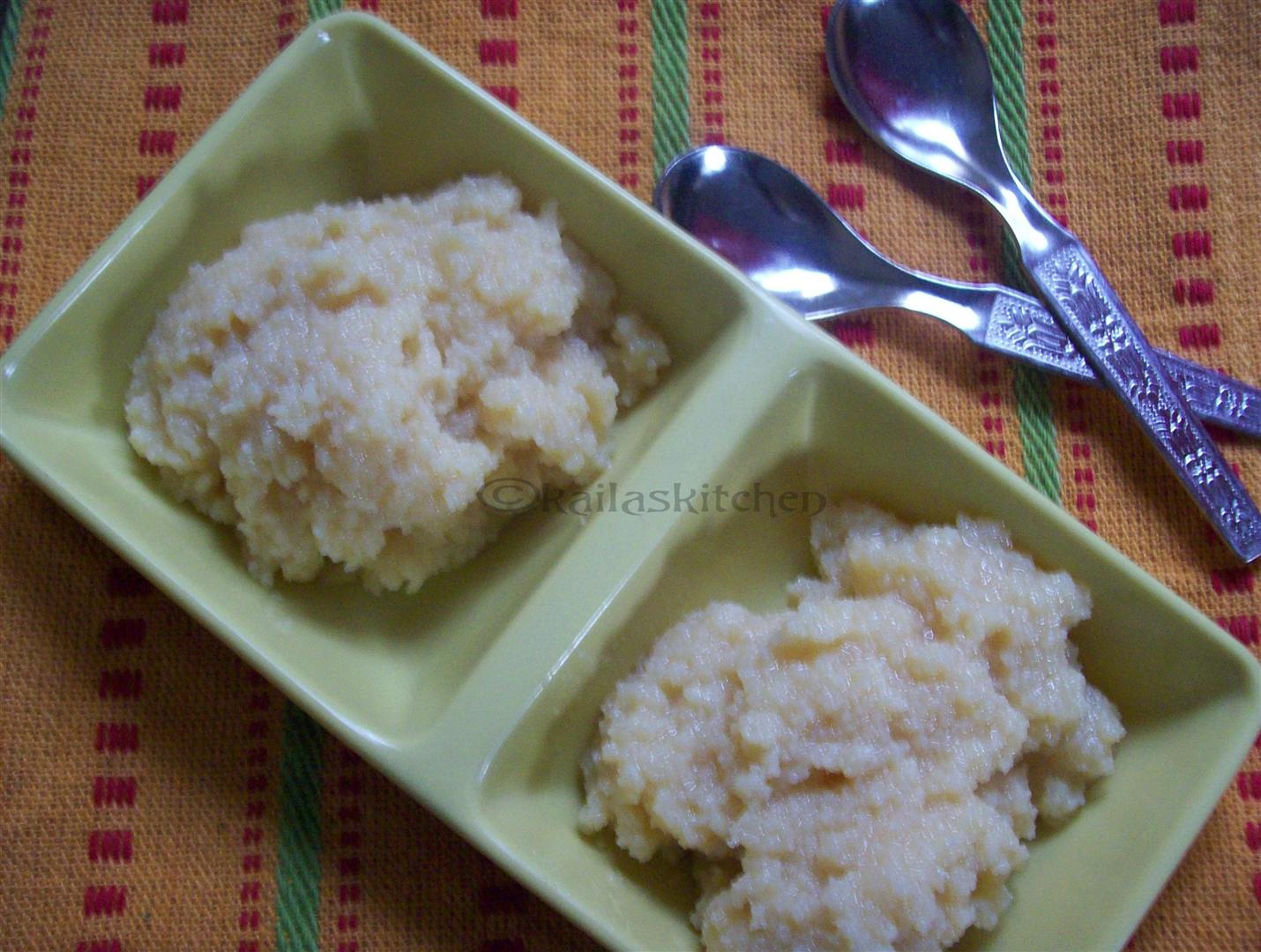
Theratti Pal - Made easy in Microwave

Theratti pal is a traditional sweet which is prepared with two ingredients - milk and sugar. The milk is boiled over low flame till it is reduced to a curdled mixture and is sweetened with sugar. Its an integral part of bhakshanam for any ritual in a Brahmin household, especially marriage. In the olden days, it was considered an exotic sweet and a tiffin box of this home made theratti pal will be invariably given to the daughter by the mother when she goes back to her in-laws home after her first visit to her maternal home post marriage. I guess the sweet is held in such high esteem, because of the patience and effort involved.  Now, what I am posting here is an instant version, which gets done in 5 minutes, in a microwave oven. 


You need

  • Milkmaid - 1 tin (400 gm)
  • Curd - 2 tspn
  • Ghee - 1 tspn
Method

Take all the ingredients in a  microwave safe bowl. Make sure you take a big bowl else it might spill over while cooking. I used 1.5 litre bowl and it almost reached the brim . Microwave high for 5 minutes. After every two minutes, give it a stir. This will ensure it doesn't spill over. At this stage, you may find some liquid. 


But after a standing time of 3 minutes, it will set well. Scoop and enjoy the delicious sweet.


I am taking this to the MEC-Potluck hosted by Srivalli.

Check out what my fellow marathoners have cooked for Day 2

February 11, 2011

Paruppu Boli With Chana dal and Sugar filling

During my childhood days, I knew only Uppittu. Back then, this made it appearance very few times in a year.  Being in a joint family, each one had access to a limited supply of these delicacy. Later, attending weddings in Chennai, introduced Boli/Poli to me. Needless to say, was hooked to those soft bolis. I started pestering amma to learn. Amma learnt it from my aunt in Chennai and thus I could enjoy them at home too. And blogging has introduced me to umpteen varieties of bolis. Post marriage, I came to know that this is a masterpiece of my MIL and I am sharing her recipe here and I have been following the same. Earlier I had posted a boli with a different filling. Here its the traditional version.


You need

For the filling
  • Chana dal/Kadala paruppu - 1 cup
  • Sugar - 1 cup
  • Cardamom powder - 1/2 tspn
  • Ghee - 1 tblspn

For the dough
  • Maida/All purpose flour - 2 cup
  • Butter/Oil - 1 tblspn
  • Turmeric - a pinch
  • Water to knead
  •  Oil or ghee to roast the boli
  •  Powdered sugar - 1/2 cup (Optional)

Method


 Mix maida, butter and turmeric in a bowl. Make sure the butter coats all the flour and this will ensure soft boli. Add water little by little and knead to get a soft dough. The dough should be firm too. Leave the dough for atleast an hour .

Pressure cook chana dal with enough water till it is soft. Drain and mash the dal. Grind the dal along with the ,sugar in a mixer grinder to get a soft paste. There should not be any granules of dal, since it will make it difficult while rolling later.

Heat a kadai. Add a teaspoon of ghee. Tip in the ground dal paste. Keep stirring till it turns dry and it should be soft too. Don't cook long, that it turns hard and lumpy.

Pinch a lemon sized dough. Roll it to 2 inch size. Keep a tablespoon of the filling. Fold the edges and cover the filling. Keep the filled edges facing down and dust it with the flour and roll like a chappathi.

Heat a tawa. When it is medium hot, place the rolled boli and cook both sides till you can see brown specs. Drizzle little oil or ghee along the edges while cooking. Remove from tawa and sprinkle little powdered sugar and fold. Enjoy munching the sweet and soft bolis. It has a shelf life of 3 days.


January 15, 2011

Pongal Special ~ Ven Pongal & Chakkarai Pongal

Wishing all my readers a very happy Pongal/Sankaranthi. Like every year, I made Ven Pongal, Chakkara Pongal and Vadai to celebrate the occasion. For a change, Husband wanted Uzhundu (urad dal) vadai  instead of the paruppu vadai, which is usually made for Pongal. I could not get fresh turmeric so tied the dried ones to the pot.


Chakkarapongal

You need
  •  Raw Rice/Pachharisi - 1/2 cup
  • Moong dal - 1/4 cup
  • Jaggery - 1 cup
  • Boiled Milk - 1/2 cup
  • Ghee - 2 tspn
  • Cashew - 10 nos
  • Raisins - 10 nos
  • Cardamom powder - 1/2 tspn


Method
Roast rice and dal separately. Pressure cook with 2 1/2 cups of water. Melt jaggery with 1/4 cup water. Filter to remove any impurities. Bring jaggery syrup to boil and stir in the cooked rice and dal. Cook on low flame till the jaggery is well absorbed by the rice,dal mix. This will not take much time and will get done quickly. Do keep stirring to avoid the mix getting stuck to the bottom. The color of the rice and dal will change to brown on cooking. Finally stir in the milk and cook for a minute or two for it blend well and remove from fire. Don't cook for longer time once the milk is added to avoid curdling.


Roast cashew nut and raisins in ghee and add it to the pongal. Finally add cardamom powder.


VenPongal

You need

 
  • Rice - 2/3 cup
  • Moong dal - 1/3 cup
  • Turmeric - a small pinch
  • Hing -1/4 tspn
  • Water - 3 cup
  • Ghee - 2 tblspn
  • Cumin seeds - 1 tspn
  • Peppercorns - 5-8 nos, crushed
  • Few curry leaves
  • Cashew nuts - 10 nos (optional)

Method

 
Dry roast rice for less than 5 minutes or so. Roast moong dal till you can smell the aroma of roasted dal and the dal would have turned light brown. Wash rice and dal together. Add 3 cups of water to rice+dal  mix. Add a pinch of turmeric and hing to it. Pressure cook till it is soft. After pressure cooking, the rice and dal would have cooked soft with no traces of water in it.


Mash it lightly with the ladle.


Heat a pan and add ghee. When ghee is hot, add cashews, cumin ,crushed pepper and curry leaves. When cashews start browning remove and add the seasoning to the rice dal mixture.


Mix well and serve hot. Coconut chutney goes well with pongal.


I shall post the vadai recipe in the next one. Until my friend, who is a follower of this blog, messaged me that she was expecting a post on pongal recipes, I didn't realize that I haven't posted the recipes here. Thanks Anu, this is specially for you.


Wishing all my readers a lovely day of celebrations with friends and family.

November 11, 2010

Kaala Jamun ~ Diwali Sweet

With instant gulab jamun mixes available in the market, making them at home is a breeze. And that is not
the case with kaala jamun. This is the third sweet which I made for Diwali.  I followed Viji akka's recipe (Vcuisine-Private blog) with slight modifications. It came out well. I was relieved when I checked if the jamuns were soft after their soaking time. And needless to say, this was my first try. The measurements of ingredients and frying plays an important role in getting soft jamuns.


You need

  • Khova/Mawa - 1 cup (Used store bought)
  • Crumbled paneer - 1 cup (used fresh home made paneer)
  • Maida/All purpose flour - 1/2 cup
  • Baking soda - 1/4 tspn
  • Water/Milk if required. (I didnot need any)
  • Oil to fry

For filling

 
Cashew/Raisins/sugar candies


For syrup

 
  • Sugar - 2 cups
  • Water -2 cups
  • Milk - 1 tbspn
  • Cardamom powder - 1 tspn

Method


Mix maida and baking soda. If your khoya is hard, grate it. Add crumbled paneer to khoya. Add all purpose flour and knead to a soft dough. If needed add milk. I used fresh paneer and the moisture from the paneer was enough and didn't not add any milk.  Be cautious in case you add milk. Do add in small quantities since the fat from khova and moisture from the paneer will be enough. Else you will end up with a sticky dough and will have to add some more of one of the ingredients and it may not yield soft jamuns.

Rest the dough for half an hour.


Sugar Syrup

 
Take sugar and water in a vessel. Bring it to a boil and add milk. Remove the scum that floats on the top. Let the syrup boil till turns sticky to touch. Add cardamom powder and remove from fire. The syrup preparation is similar to what we make for Gulab jamun.


Frying the jamun
 
Knead the dough and make gooseberry sized balls of the dough. Keep cashew/raisin/sugar candy in the
centre and roll it again with out any cracks.


Heat oil till it is moderately hot.  Add 4 balls at a time. After few seconds, lower the heat to the lowest and fry till it is dark brown in color. Note that you don't fry it  for longer time after it gets that  dark color else you
will end up with hard crust jamuns.

 
Drain the jamuns and put it in the sugar syrup. Fry all the remaining jamuns. In case if you feel the oil has become too hot, switch off the stove for few minutes and then start again.
  
Jamuns should soak in the syrup for 7 hours. After its soaked well, remove them from the syrup and transfer to the serving tray. Leave the unused jamuns in the syrup.  Garnish the jamuns with grated coconut or chopped nuts.


Enjoy delicious, soft jamuns with nutty centres.


November 9, 2010

Boondhi Ladoo ~ Diwali Sweet

Hope all of you had a safe and fun filled Diwali. While planning for Diwali Sweets, I try to include the ones which are in my to-do list. And most of the time, the ones which requires time and energy gets into the list, since its festival and I am all out to slog that extra hours in the kitchen. The first sweet to be ticked this time was Boondhi Ladoo and my MIL was game for it since she had made only once and that was with her mother taking the lead. And its first time for me, though I have enough experience in rolling the laddus. (My college mates will agree to this). I checked the measurements and thread consistency for the syrup, with my mom. My mom gave the measurements in kilograms and I scaled it down to cups which is easier for me, since I was making a small quantity.

 
Making ladoo is quite easy though it involves some work. There is nothing much to go wrong in this, if you follow the method properly.


You need


  • Besan/Kadalamavu - 2 cups
  • Yellow color - a pinch
  • Sugar - 3 cups
  • Water - 1/2 cup
  • Milk - 1 tspn
  • Cashews, raisins, sugar candy(kalkandu) - a handful
  • Cardamom/Elaichi powder - 1 tspn
  • Ghee - 1 tblspn
  • Oil to deep fry

 
Cloves and edible camphor can also be added. I omitted them.

 
Method

Preparing the syrup

 
First prepare the sugar syrup to soak the boondhis.  Heat water and sugar in a deep bottom vessel. When the sugar is fully dissolved, add a teaspoon of milk and let the syrup boil. The impurities in the sugar will float on top. Remove the scum with a ladle. Boil the syrup to one thread consistency. You can check by dropping some syrup to a small bowl of water. If the syrup stays in water and it is rollable, then you can switch of the stove. Take care that you don't make a thick syrup, since rolling laddus will not be easy and it will not hold shape also.

 
Roast Cashews and raisins in ghee. Add it to the syrup. Stir in the cardamom powder also. Keep it aside.
Don't add the sugar candy at this stage.

 
Preparing Boondhis

 
Take the besan in a bowl. Mix in a pinch of yellow color. Add water and make a lump free batter. The batter should be similar to dosa batter. To make boondhi, a special ladle is available in the market. I don't have one. I used the normal slotted ladle which has big holes in it. It worked fine for me. To check the batter consistency, try droping the batter on the ladle over the batter mix. You can see how the batter falls down.  If it doesn't fall in drops, you can add some more besan to adjust the consistency.


Heat oil in a wide pan. Heat moderately. Hold the ladle above the oil. The height of the ladle determines the shape of the boondhi. So hold it high. While making the boondhi, we tend to lower it near the oil, and you will end up with tiny boondhis. The boondhis get fried very quickly. Drain them before they turn very crisp. Add the drained boondhis to the syrup. Continue making boondhis till you finish the batter. Gently mix the syrup after addition of each batch of boondhis. The hot boondhis will keep the syrup warm. Finally add the sugar candies. We are not adding it at the beginning since it might melt in the hot syrup.


The final assembly

Take a handful of the soaked boondhis and press it in your fist and roll into laddoos. You should press it well while shaping, so it holds shape and remains firm on cooling also.


I got around 32 ladoos with this measurement.


August 30, 2010

Mathan Pradhaman - Pumpkin cooked in jaggery syrup and coconut milk

Before I move on with posting the other recipes in my drafts, let me finish off the dishes that I made during the festivals in the last week. Last week, for two days together, it was festive lunch on account of Onam and Avaniavittom. For Onam, I made paladapradhaman. While I was chatting with my cousin over phone, who is a great foodie himself, asked me the payasams I am planning for  the oncoming festivals. I had decided paladapradhaman to make from scratch and I was contemplating on various options for another payasam. It was then he suggested about mathan paradhaman. He reminiscenced that our grand father had prepared this for grihapravesam after my parents wedding. And then, no one could find out the ingredient in the pradhaman. Recalling those instances were enough for me to decide that I will make this for Avaniavittom, provided I get ripe pumpkin.


You need

  • Cooked and pureed pumpkin - 1 cup heaped
  • Powdered jaggery - 1 1/2 cups
  • Coconut milk - 3 halves of coconut
  • Coconut bits fried in ghee - 2 tblspn
  • Dry ginger powder -1/2 tspn

Method

Chop pumpkin into cubes. Pressure cook with just enough water to cover the pieces for 2 whistles. You can cook on stove top also till it is mashable. Drain the water and mash the pumpkin pieces till smooth. Alternatively can pulse for few seconds in the mixer grinder. The drained water can be used in soups.

Extract three sets of milk from freshly grated coconuts. I have written here about extracting milk.

Melt jaggery in a cup of water and strain for any impurities. Heat the melted jaggery syrup in a thick bottomed vessel. When the syrup thickens, stir in the pumpkin puree. Continue cooking till it thickens to a flaky consistency so that the pumpkin must have absorbed the sweetness very well. Add the third, thin coconut milk and keep stirring. When it reduces to half in volume, add the second, slightly thick coconut milk and continue cooking till it reduces to almost half in volume. Switch off the heat and stir in the first, thick coconut milk. Heat ghee in a pan and fry the coconut bits till brown. I did not have any coconut left so fried cashews instead. Add dry ginger powder. 


My husband and mother-in-law and friends who tasted this payasam could not guess the ingredient as pumpkin. It was very tasty and creamy, similar to parippu pradhaman.

P.S Watch out for the review of  a cook book, which contains recipes from a leading restaurant chain in India.


February 16, 2010

Paruppu Kanji ~ Shivarathri Special and Diet Chart Week#1, Day~1

Paruppu kanji is synonymous with Sivarathri. I remember its made only on the Sivarathri day at home and I too continue that tradition, inpsite of it being a simple, no fuss recipe. I guess, this simple, lighter version of payasam/kheer is more special since its made only once in a year. That special appearance in the menu helps to retain the charm. The paruppu referred in the name is moong dal and kanji means porridge. Paruppu kanji is usually prepared in the evening of Sivarathri day. Usually, for Sivarathri, a dawn to dusk fast is observed. May be to break the fast, this kanji is made.

Its not a complicated recipe. Jaggery is added to cooked moong dal and cooked again to blend and finally boiled milk is added to dal-jaggery mix.  If you have cooked dal ready, then it is very simple to put together.  Its a healthy drink to keep yourself warm during winter.


You need


Lightly roasted moong dal - 1/2 cup

Jaggery -1/2 cup.

Boiled Milk - 1 cup

Cardamom powder - 1/2 tspn


Method

I usually roast moong dal before storing. Lightly roast the dal till you can smell the aroma. Wash and pressure cook in two cups of water. Lightly mash the cooked dal for a creamier consistency of the kanji. Add jaggery to the cooked dal along with the water its cooked with. Give a stir once in a while. The jaggery will melt and blend with the dal. Finally add a cup of milk and bring to a boil. Don't boil too much after adding the milk. Add cardamom powder and serve hot. You can bite into bits of the dal, though its almost liquid in consistency. Amount of jaggery and milk can vary according to your  preference.


Diet Chart Week #1 Day~1


For a long time, I wanted to go on an healthy diet atleast for few days in a month. But I was undecided as to
where to start with. Also could not come up with a healthy menu to follow. Then I decided to go off on sweet/deep fried on 2 days in a week. My husband was also ready to join in. We did that successfully for 3 months. Then the month of December saw many relatives visiting and various festivals. We fell back to our
old days. I was thinking of restarting that again and I saw Srivalli's diet program. Srivalli had charted the menu with help of her doctor father. And that was the kind of pointer I was looking for. It was easier to follow hers, since she too is a South Indian vegetarian. For the time being, I have planned to follow alternative weeks for a month and then later for two consecutive weeks. As for the first day, it went fine with out much trouble.  Though I did feel slight discomfort in the form of headache. But it was manageable. Thanks Srivalli for the inspire. Here is my chart for Day1.  My day starts at 5:15 a.m


6:00 a.m - 1 tspn ajwain/omam + 1 glass warm water

7:00 a.m - 3/4 cup coffee + 1/2 tspn sugar

9:15 a.m - 2 slices of wheat bread, toasted + 1 cup of moong sprouts+ cabbage salad

(MW sprouts and shredded cabbage for 4 minutes and added a dash of lime and pinch of salt)

11:15 a.m - half cucumber

1:00 p.m - 2 phulkas, Yard long beans/payar thoran/stir fry,radish sambhar and a glass of buttermilk

3:45 p.m - half cucumber and a glass of buttermilk

4:15 p.m - 3 slices of pineapple

5:45 p.m - 1 cup of tea with half tspn of sugar

7:15 p.m - cauliflower +ashgourd soup

8:30 p.m - 2 phulkas +snake gourd stir fry , tomato+onion salad, buttermilk

9:45 p.m - watermelon

Through the day, I have had 9 glasses of water (update - 2 glasses of lemon juice with honey) and 3 glasses of buttermilk.


I decided to blog the diet plan for future reference and also if it might be a motiviation for any of my readers to begin with. And since I have announced it here, that will be another reason for me to stick with the plan.



January 7, 2010

Thiruvathirai Kali and Poduthuval

Hope and wish you all had a lovely start to the New Year. After the celebrations, every one must be back to routine. So am I. We had all most all of the family here for the New Year except my eldest co-sister and niece. We missed them very much. Since Thiruvathirai was celebrated on the 1st, the day started pretty early for me (3:30 A.M) to go to the temple to have the Aruthra Darsanam (The pre-dawn hours of the full moon night, in the month of Margazhi/Danu with the longest nights in the year, marks the auspicious time for Arudhra Darshan). The specialty food for thriuvathirai is kali and poduthuval. Kali is roasted and powdered rice cooked in jaggery syrup. The sweet dish is served with a spicy side- Poduthuval. The main ingredient for the poduthuval is Kavathu and Avarakkai. Some add pumpkin, raw banana etc to it. Each family has their own recipe. In Kerala, many take upvaas/nolumbu on the day and they abstain from eating rice. Kali is made using arrowroot powder and will have consistency of payasam. During the time of thiruvathirai, shops sell this arrowroot powder. I usually stock it up during this season.


Thiruvathira Kali


Raw rice - 1 cup

Powdered jaggery - 1 cup

Whole moong dal - 2 tblspn

Water - 2 cups

Grated coconut - 3 tblspsn

Elaichi powder - 1/4 tspn

Ghee - 1 tblspn


Wash and drain rice. Roast it over low flame till it is pink. Roast moong dal for few minutes tillyou smell the flavor.  Cool and powder rice and moong dal, not very fine. It should be like rava, slightly coarse and grainy. Then only you will get fluffy kali else it will end up in a sticky mass.


Heat water in a kadai/uruli. When water gets heated, add the powdered jaggery. Bring it a boil. When it starts boiling, stir in the powdered rice rava. Lower the flame and let it cook for few minutes. The water will be fully absorbed as the rice rava gets cooked. Add a tablespoon of ghee and elaichi powder. When the kali appears dry and fluffy, stir in the grated coconut and remove from fire. Cover and leave it to cool. Kali taste best when it is cold.


It’s very easy to prepare kali provided you get the measurements right. The amount of water might differ according to the variety of rice. Usually the ratio of rice to water is 1:2.  This time, I made kali from 3 cups of rice.


Kavathu Poduthuval


Kavathu chopped into cubes - 2 cups

Avarakkai/Indian broad beans - 8 nos

Salt to taste

Turmeric a pinch


To grind

Grated coconut - 1/2 cup

Green chilly - 3 nos


To season

Coconut oil - 1 tblspn

Mustard seeds - 1/2 tspn

Red chilly - 2 nos

Curry leaves


Method

Wash and peel the skin from the kavathu. Chop them into 1 inch cubes. String the beans and cut one into 2 or 3 pieces according to the size. Add turmeric and enough water to the pressure cooker along with the cut vegetables. Pressure cook for two whistles. The consistency of the poduthuval will be of thick gravy. Some prefer it to be dry. This is each one's personal choice. We like it slightly gravy but not runny kind.


Grind the coconut and green chilly coarsely without adding water. Add the ground coconut and salt to the cooked vegetable and bring to a boil. Adjust the consistency by adding water if needed. Do the seasoning and serve hot with the cold kali. This is the only festival I remember where a sweet dish is served with a salty side.


On a different note:

One of my readers Shrilatha sent me pics of recipes tried from Kailas Kitchen along with the New Year wishes. She really made my day. I am happy to share the pics with you all. Thanks Shri for sending the pics across.


December 2, 2009

Karthikai Deepam


Hope all of you who celebrates Karthigai Deepam had a lovely celebration.  Karthikai, is the festival of lights can be explained as a combination of Raksha Bandan and Diwali, for the uninitiated. The lamps are lit for the well being of one's brothers. Small earthen lamps/brass lamps are lit in the front yard and placed on rangoli/kolam. The brass lamps are usually given to a girl as part of the wedding trousseau. In Kerala, only  the iyers celebrate the festival. In my neighborhood, others also join the celebration by lighting the lamps in their front yard, though they don't prepare any festive goodies as we do. So the whole street is a sight to behold. Neiappam, pori and Adai with vennai is the usual neivadyam. I made all the three.


Diced coconut is a common ingredient for all the three dishes. Fresh coconut is sliced as thin strips. The strips are then cut into bite sized pieces. I used half of a fresh coconut. The credit for equal sized pieces goes to my Dad.


Neiappam

As the name suggests, Nei is ghee. These sweetened rice balls are fried in ghee in a special pan which has depressions. I have used half and half of ghee and oil. There are many ways to prepare the batter. I have been following this way. 

Ingredients

Raw rice /pacharisi - 1 cup
Jaggery - 1 cup
cardamom powder - 1 tblspn
Half of a banana
Diced coconut pieces - 2 tblspn

Ghee/oil to fry


Wash and soak raw rice for 8 hours. More soaking helps in getting softer appams.  Drain the water. Powder the jaggery. Grind together jaggery and rice to a smooth paste. Add the banana too. Don't add water while grinding. If you are using more rice quantity, then you can use the wet grinder instead of the mixer grinder. Since we are grinding without water, your mixer grinder will get heated up fast and it will take more time to prepare the batter. Stir in the coconut pieces and cardamom powder. The batter consistency should be that of  idli batter. If it is too thick, adjust by adding water. Give a good stir everytime you scoop the batter into the pan.


Heat the appam pan. Fill ghee/oil to 1/2 the level of the depressions. When it is hot, drop spoonfuls of batter into the depression. Cook in moderate heat, so that the inside also gets cooked and you get a lovely golden color. After a minute, gently turn them upside down. Don't wait for the downside to get cooked well. When you do  like this, the uncooked batter flows outside on turning and a similar appam is formed on the flip side. So you will get an appam which looks like one is placed on top of the other. This is not easy as it is written.

Everytime I start making, I try to get this effect. But by the time, my appam pan is set and I get the drift, the batter will be over. I must confess I usually make appam only as part of any festive fare. I always think of making it on other days for the sake of practise. It never seems to happen. Don't bother too much if you are not getting it, this has nothing to do with the taste of the appam. It only contributes to the looks factor.


After a batch, check the oil in the depressions and add if required. If you add oil, wait for it to get hot before starting with the next batch.


Aval pori in jaggery syrup

My mom used to make nel pori  for Kathikai. My MIL makes aval pori (fried beaten rice flakes). In the place where I stay, everyone seems to make aval pori only since the vendors bring that and less quantity of nel pori. And personally I favor aval pori. My amma's measurement is in terms of edangazhi (measuring vessel) and achu ( jaggery blocks). Her version is for 1 edangazhi (approx 1 litre)  pori, 10-12 achu vellam (jaggery block) depending on the size of the block. Based on her measurement, I have a an easier measurement, ie for 5 measures of pori, 1 measure of powdered jaggery. That works fine for me. Measure the pori with a cup or bowl. With the same bowl measure out the jaggery also. The  jaggery syrup consistency is very important, since it helps to retain the crispness of the pori after coating in the syrup.


Ingredients

Pori - 5 measures
Jaggery - 1 measure
cardamom powder - 1 tblpsn
diced coconut pieces - handful

Method
Melt the jaggery with just enough water for it to melt. Strain and heat the melted jaggery. The syrup consistecy is 'kallu pakam'. Its the next stage of soft ball consistency. You drop a teaspoon of the syrup in half cup water and roll it into a ball. When you drop the ball, you should be able to hear the sound of it hitting the surface. If the syrup has attained the consistency, switch off the heat. Stir in the cardamom powder and coconut pieces. Slowly stir in the pori, gently giving a mix while adding. turn the pori well so that it gets coated in the syrup. While warm, you can roll into balls. When you are making in small quantity, its easy to roll. I made nearly half a kilogram of pori. So i made just few balls and left the rest as it is.


Adai


The recipe of karthikai adai is slightly different than the one prepared usually at home. Since it is offered as neivedyam only raw rice is used. That is boiled rice is avoided completely thought its used only in minimal quantity otherwise too. Pepper corns and jeera/cumin is added while preparing the batter. It surely gives a nice flavor. Also the diced coconuts are added too. It is offered along with home made butter.


October 20, 2009

Vanilla Maida Cake, Ukkarai & Kaja ~ Diwali Sweets

Vanilla Maida Cake


This is Lalitha Maam's masterpiece recipe. Aunt makes it with different flavors and changes the color accordingly. I have always made with vanilla essence and used green color. This time my husband suggested to change the color. When I checked for yellow color, very little was left. I add a pinch of green to that yellow color and got a greenish yellow color. This is very easy to make provided you get the sugar syrup consistency correct, which is important for all Indian sweets.


Time : 20 minutes
Yields - 50 pieces

Maida/All purpose flour - 2 cups

Sugar - 4 cups

Ghee - 1 1/2 cup

Vanilla essence - 1 tspn

Food color - a pinch

Water - 1 cup


Heat ghee in a kadai. When it is hot, stir in the maida and switch off the stove. The maida gets cooked in the warm ghee. In another kadai, prepare the sugar syrup with 4 cups of sugar and 1 cup of water. When the syrup starts bubbling, add a tablespoon of milk. Let it continue to simmer. The scum will float on top and gently remove with a spoon. The sugar syrup should be of two string consistency, which is very important for this recipe. To check the consistency, wet your fingers and then take a drop of the syrup on your index finger. If stretched between your index and thumb fingers, you should be able to see two threads. If the syrup cooks beyond two thread is al so fine but not less, since much cooking is not done post that stage. Add vanilla essence and food color to the syrup. Stir in the maida+ghee mixture. And cook for two minutes till it comes together as one whole lump. Once maida is added to the syrup, you should act quickly. Once the sugar syrup has reached consistency, swtich off the stove. Mix in the mixture and give vigourus stir so that it blends in. Then heat the stove again.


Grease a plate with sufficient ghee and also a flat based cup (I use dhabhara) to level the mix once it is transferred to the plate. Since the cake has a soft texture, it doesn't set quickly. So you have time to level it perfectly. But you need to transfer the mix to the plate immediately from the kadai else the last portion left in the kadai tend to set faster leaving some granule texture to that part of the cake.


Ukkarai

This is a tradional sweet, made for Diwali in most of the Kerala Iyer homes, though i don't make it for every Diwali. This time around, I wanted to make it for memory sake.

1/2 cup tuvar dal

1/2 C chana dal or use 1 cup of chana dal alone

1 cup jaggery

3 tblspn ghee

Elaichi powder

Roasted cashew - few

Grated coconut - 3 tblspn


Roast both the dals till light brown. Pressure cook till it is soft and not mushy. Drain the excess water. Pulse the cooked dal along with coconut to a smooth paste.

Heat jaggery in 1/4 cup of water. Make syrup till it reaches the soft ball consistency. A drop of the syrup dropped in a tablespoon of water,should be able to roll into a soft ball. Stir in the ground dal + coconut paste. Keep stirring till the jaggery syrup is full absorbed by the dal and it turns dry. Add ghee at intervals. Mix in roasted cashew and cardamom powder. The texture is soft but not sticky.


Kaja ~ Andhra Special

I had the recipe noted in my diary, long back, taken from a Tamil magazine. In the magazine, the recipe was named as Curly Biscuits. The recipe was new to me and seeing the name I thought it as an innovative recipe. I had tried it then.  Later, blogging introduced me various regional specialities and I found the sweet is Kaja, a speciality of Andhra. I understand there are varieties of Kaja, marked by regional variations. I found a similar recipe at Srivalli's. Valli has neatly explained with step-by-step pics.


Preparing dough - 15 minutes
Resting time - 1 hour
Making kajas, deep frying, and clicking photos - 1 hour

Ingredients

Maida/All purpose flour - 2 cups

Salt - a pinch

Baking soda - 1 big pinch

Ghee - 2 tspn + 2 tblspn

Rice flour - 3 tblspn

Water - 3/4 cup


Oil to deep fry


Syrup

Sugar -1 cup heaped

Water - 3/4 cup


Mix maida, salt, baking soda and ghee. Add water to make a pliable dough. Leave the dough for an hour.  Resting time for the dough is essential to get good results. In a bowl mix together rice flour and ghee.It should be of spreadable consistency.


Pinch of a ping pong sized dough. Roll into a chappathi. Spread the rice flour + ghee paste on it.


Place another chapathi on it. Fold it from one end.


Lightly press the edges so that it sticks and doesn't open up. Cut intp 1 inch long pieces.


Slightly press them down to flatten the pieces.


Deep fry the pieces in moderate heat. Don't heat the oil to smoking point and fry in high flame. The inside layers will not get cooked.

Mean while prepare sugar syrup for one string consistency. Dip the fried kajas in the sugar pieces. Leave it for 2 minutes. Then remove them and spread it on a plate to cool.